
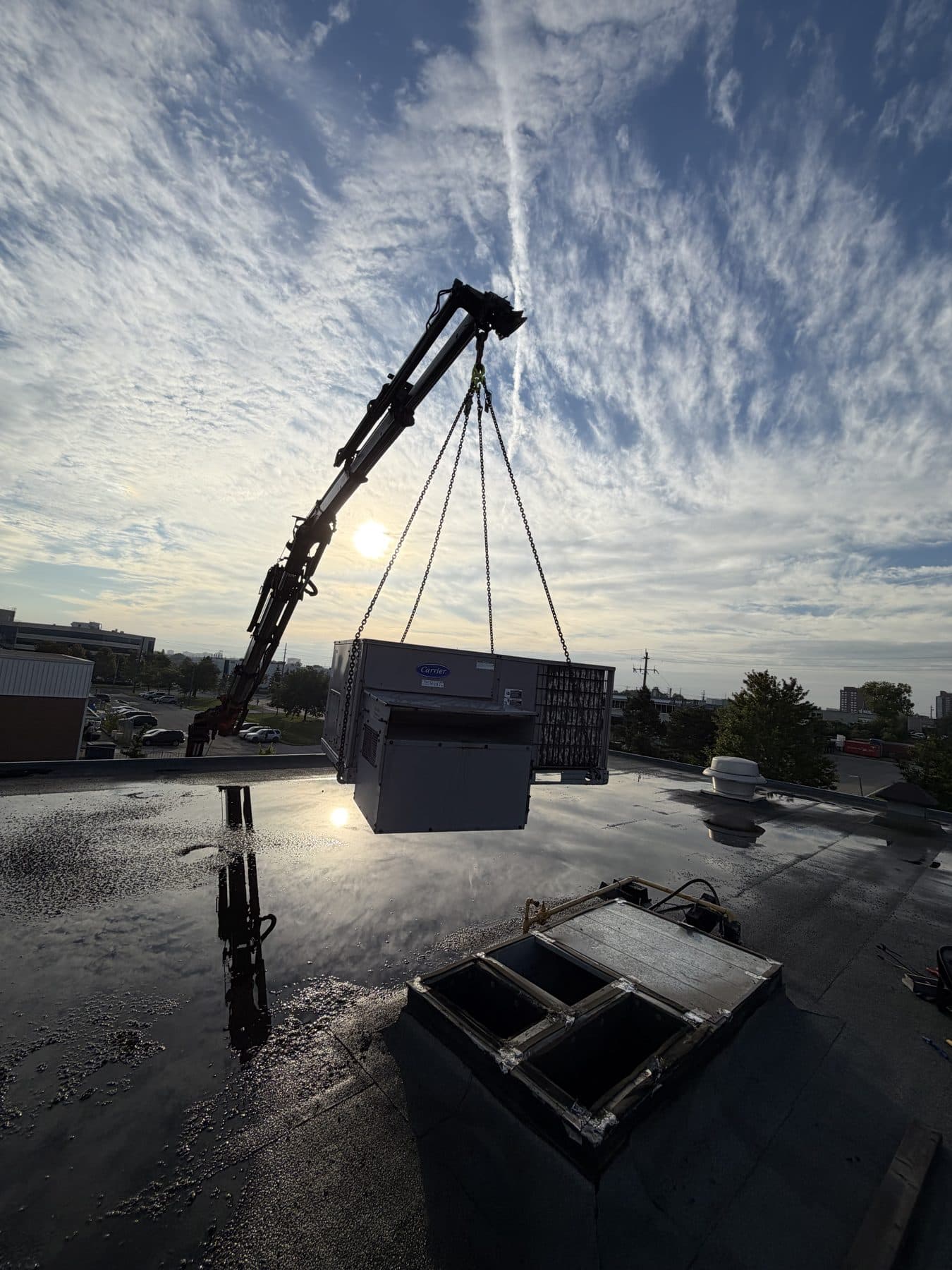
Start with the curb
The existing curb is what the new unit lands on, and it's the first thing we check, before ordering anything. A curb built for one brand's footprint doesn't always match another's supply and return openings or duct connections.
When the footprint doesn't match, a curb adapter closes the gap so the new unit sits square and sealed on the old curb instead of the roof being reframed. We check the curb's condition too: a rusted or rotted curb gets addressed before a new unit goes on top of it.
Planning the crane lift
A new rooftop unit almost always goes up by crane, and that means planning around more than the unit itself. We look at where the crane and truck can set up, whether that's the parking lot, the road, or a laneway, and what it does to access for tenants and customers during the lift.
On a tight lot or a busy arterial, the lift gets scheduled for a window that works for the building, not just for us. Property managers usually want tenants notified ahead of a crane truck showing up outside.
Hookup order once the unit is set
Once the new unit is set on the curb, the connections go in order: gas and power first, then the controls that tie it into the building's thermostats or building automation. Each connection is tested before the unit is started, and the unit is run through a heating and cooling cycle before the crew leaves the roof.
R-22 and the case for replacing rather than repairing
R-22 is no longer made or imported in Canada, so a refrigerant leak on an older R-22 unit is expensive to recharge, sometimes more than the unit is worth. That's usually the point where replacement gets discussed instead of another repair. A unit at the end of its service life on the equipment schedule, or one needing repairs every season, points the same direction.
Working from the equipment schedule
We quote a replacement from the building's equipment schedule, and for larger or mixed-use buildings, an engineer's load calculation. A restaurant unit, a retail unit, and an office floor load differently even at the same square footage, so the schedule or the calculation sets the size we order to, not a guess from the old nameplate alone.
If a property manager doesn't have a current schedule, we can put nameplate and condition details together on the first visit.
Scheduling around the building
A replacement is disruptive by nature: the suite below is without heating or cooling for part of the day, and a crane and truck are outside. We plan the date with building management, including tenant notice, and hand over a written quote before ordering anything. See rooftop unit maintenance for what keeps a unit running until it's time to replace it.