
What we check first
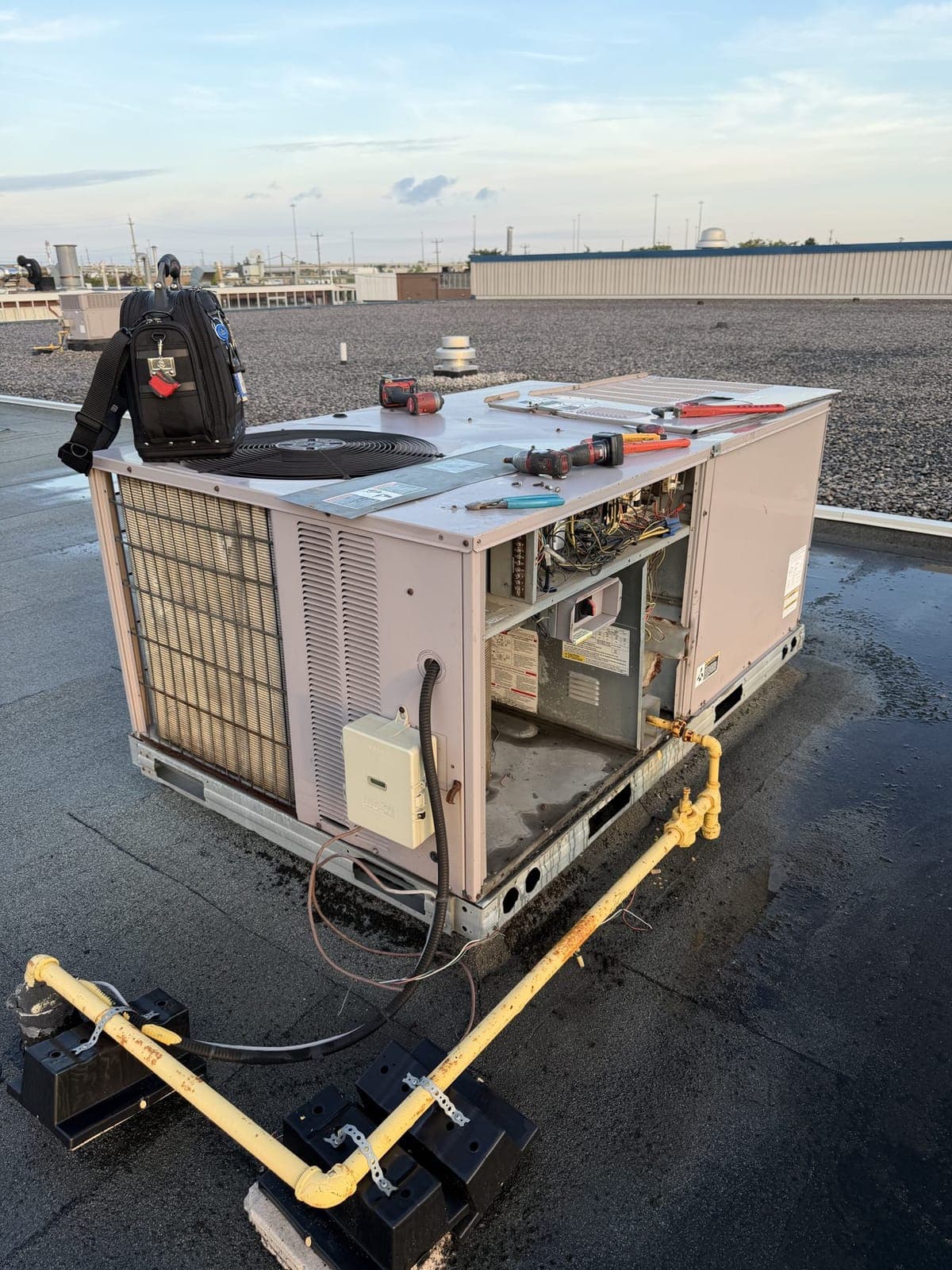
A rooftop unit that has stopped heating or cooling a suite almost always points to one of a short list of parts. We start with the ones that fail most often: the igniter and flame sensor on the gas side, the belt and blower, the control board and contactor, and the refrigerant circuit. Testing the unit while it runs on the roof tells us more in ten minutes than a description over the phone.
We work on Carrier, Trane, York, Lennox, Daikin, KeepRite, Engineered Air, and AAON rooftop units, including ones we did not install.
Igniter, flame sensor, and the heat side
Most no-heat calls on a gas rooftop unit trace back to the igniter or the flame sensor. The igniter has to glow hot enough to light the burners, and the flame sensor has to prove the flame is there before the control board lets the gas valve stay open. Either one failing shuts the unit down, sometimes with a fault code on the board and sometimes with nothing but a blower running cold air.
We check both with the unit firing, along with the burners, the heat exchanger, and gas pressure at the valve.
Belts, control board, and contactor
A slipping or broken belt cuts airflow across the coil, which shows up as weak output, a squeal from the roof, or the blower cycling on a high-limit trip. We check belt tension, wear, and pulley alignment along with the bearings behind them.
On the electrical side, a pitted contactor or a faulted control board can stop a unit cold or cause it to short-cycle. We test motor amperage against the nameplate and look at the board and contactor for burn marks or corrosion before replacing anything.
Refrigerant leaks and the condensate drain
Low cooling output on a unit that runs constantly is often a refrigerant leak, not just a low charge. We find the leak first. Topping up refrigerant on a unit that keeps losing it just means the call repeats next month.
A blocked condensate drain is a different problem with a similar symptom: the unit runs, but water backs up into the pan and can overflow into the ceiling below. We clear the drain and trap and check the pan for rust or cracks.
The economizer and what it changes
An economizer brings in outdoor air instead of running the compressor when conditions allow, and a stuck damper either wastes that or pulls in too much cold air in winter. We test the dampers through their range as part of a repair call, since a faulted economizer can look like a heating or cooling complaint from inside the suite.
Roof access and tenant scheduling
Every building reaches its roof differently: an interior stair, a roof hatch with a fixed ladder, or an exterior ladder. We confirm how the roof is reached and who holds the keys before the visit, so nobody is standing at a locked hatch.
For an occupied suite, we coordinate the visit with building management so tenants know when work is happening above them. See commercial HVAC maintenance for how scheduled visits differ from a repair call.