
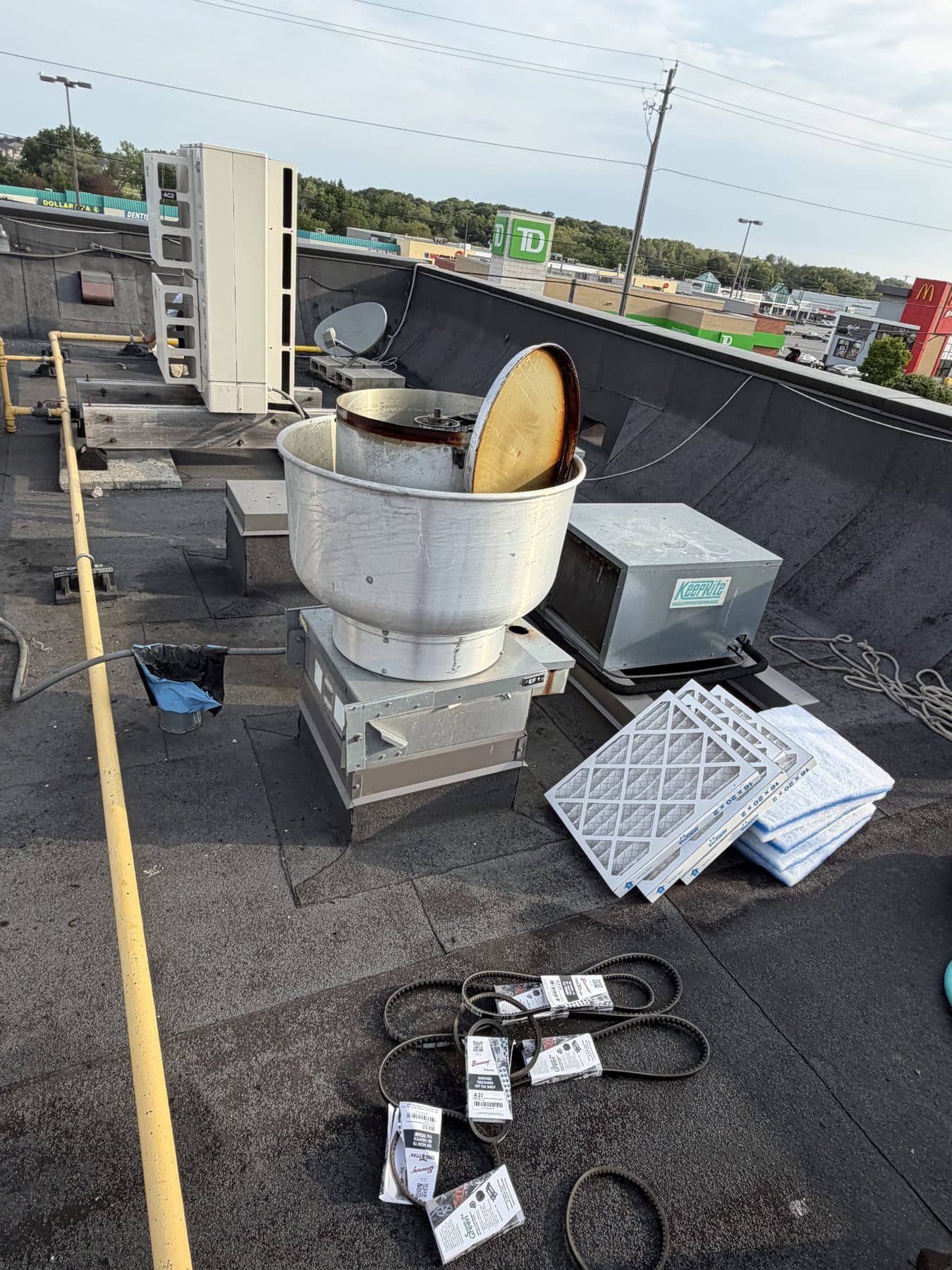
What a make-up air unit does
A kitchen exhaust hood, a bank of dryers, or a large exhaust fan pulls a lot of air out of a building. A make-up air unit (MUA) brings outdoor air back in to replace it, heated in winter so the space isn't pulling in cold air through every gap it can find. When the MUA is undersized, off, or faulted, the space it serves runs negative: doors get hard to pull open, drafts show up at thresholds, and whatever the exhaust is trying to clear works harder than it should.
We service and install make-up air units from Engineered Air, Reznor, Cambridge, Greenheck, and CaptiveAire.
Burner and ignition
Most MUAs used in Toronto are gas-fired, with a burner section similar to a rooftop unit's heat side. We check the igniter, the burner, and gas pressure at the valve, and confirm the unit lights reliably rather than tripping on a failed ignition attempt.
Filters and the belt-driven fan
The intake filters keep debris out of the burner and the fan, and a plugged filter cuts the air the unit can move, which shows up as less make-up air reaching the space even though the unit is running. We check filter condition on every service call.
Most MUAs move air with a belt-driven fan. We check belt tension and wear the same way we do on a rooftop unit, since a slipping belt has the same effect here: less air, more noise.
Dampers and the interlock
An MUA has a damper that opens when the unit calls for outdoor air and closes when it's off, so the space isn't left open to outdoor air overnight. We test that it opens and closes through its full range.
The interlock ties the MUA to whatever it's replacing air for, a kitchen hood fan or a bank of dryers, so the MUA starts when the exhaust does. A faulted interlock means the exhaust runs without any make-up air behind it, which is usually when the symptoms below show up.
What the symptoms usually mean
Doors that suddenly pull hard, a draft at the front entrance, a kitchen hood that won't clear smoke the way it used to, or dryers that run long without drying, all point back to the same place: not enough replacement air getting into the building. We check the MUA, its controls, and whether it starts when the exhaust fan does before looking anywhere else.